

Last Mile Delivery Optimization
Time To Value And Its Importance For the Last Mile


Key Takeaways
- Time to value in last-mile delivery represents the duration between implementing a dispatch management solution and achieving positive ROI, directly impacting operational efficiency and customer satisfaction.
- Modern customers have become increasingly intolerant of delays, making rapid value realization crucial as last-mile delivery costs account for 53% of total shipping expenses.
- Building an in-house dispatch management solution typically takes 6-12 months for initial deployment, with potential cost overruns of 27% due to implementation delays.
- Locus’s API-first dispatch management platform enables quick integration with existing systems and provides dedicated support, reducing time to value to just weeks through streamlined onboarding and implementation.
This NBA season is witnessing a new set of debates!
Issues like load management and disciplining the referees for missed calls are making the rounds. But we are not going to talk about it now.
Say James is about to play a basketball game in a week that decides his spot in an NBA team. Before that, he wanted to purchase a pair of shoes from a nearby store.
The shopkeeper presented him with two sets of Nike shoes. The first pair of shoes is 60% off, but it’s locked in a puzzle box with a problematic math sum to solve. It demands some number-crunching to open it. Opening it might take hours, days, weeks, or even months. The second set of shoes has no discount, and he could start wearing them today.
Which one will he choose? It is important to understand the concept of Time to Value.
What is time to value in last-mile delivery?
Time to value is the time customers spend to derive value from the purchased product. In last-mile delivery, it is the time gap between buying a dispatch management solution and gaining a positive Return On Investment (ROI) from it.
Coming back to the scenario, it’s obvious that James will go for the second option despite it not having any discount.
Why so? Because He wants to wear the shoes and start practicing to get used to playing with them. It means he wants to derive the value out of these shoes quickly. This time between purchasing the shoes and deriving value from them is what we call business as the time to value.
By value, we mean the benefit a customer expects from a product. It is not what a business wants to deliver; it’s the perceived value from the customer’s perspective. For instance, a retailer or delivery partner expects to increase the number of deliveries completed successfully in its first attempt from dispatch management software. The business receives the value from the software when its On-time In-Full (OTIF) and First Attempted Delivery Rates (FADR) increase.
Types of time to value
Time to value varies between different industries, businesses, companies, and customer priorities. By understanding the types of time to value, your business can work with the right tech partner.
Time to basic value
Time to basic value is the lowest time a customer takes to realize the most negligible value from a product or service. It is the most fundamental value a customer experiences and is yet to utilize fully. A sample product or free trial is the best example of this.
Time to exceed value
Time to exceed value is when a product or service provides customers a deeper level of value. By improving the time to exceed value, businesses can improve their customer lifetime value.
Long time to value
Some products, like SaaS solutions, take a long time to provide value to customers. This time may span weeks to months owing to integrating systems and data for different parts of a business.
Short time to value
Short time to value is the time a customer takes to recognize the value of a product quickly. It happens when a business uses the platform with relatively little user onboarding. The downside of this short time to value is that customers need more patience and loyalty. When another brand does this quicker, they move on to them.
Immediate time to value
Immediate time to value, as it suggests, is the quick return a customer obtains once they start using the product. For instance, this may include a solution that immediately gives value, like cloud document storage.
Why does your business need time to value?
A few decades ago, customers (businesses that purchased SaaS solutions) stuck to perpetual licenses for solutions. Because it was a sunk cost, they stuck to the purchase and deployment and used them until they returned values. Time to value was not a critical factor for them as it is today.
Today, customers have become intolerant of delays. Even minor frustrations can result in customers exiting services.
Every customer wants a smooth and simplified onboarding experience. And they want a technology that quickly starts giving them a return on investment in their last-mile delivery.
Last-mile delivery accounts for 53% of total shipping costs. Managing last-mile delivery costs is difficult with constraints like rising fuel costs, lack of drivers, increased traffic congestion, time windows, and route complexities.
These constraints can eat up the costs and disturb your margins if not looked after. A robust dispatch management software with its simplified onboarding process can minimize your time to value. A minimized time to value means you get the returns on money, effort, and time invested quickly.
Can I build my dispatch management solution to minimize the time to value?
Yes, your business can build a dispatch management platform to reduce time to value. But when you prefer to develop a user-friendly solution, it might take at least 6 to 12 months to complete its first version. You can reduce the cost of ownership, but your time to value will increase. Even a slight delay in the decision-making process during these circumstances will result in a cost overrun of 27%.
Buying or building a solution to minimize time to value is a long-standing debate in the tech world. Ultimately, your business makes the final call on prioritizing time to value or cost of ownership.
With a market-ready industrial solution like Locus, you can reach the market faster and recognize your ROI. When you partner with a tech platform like Locus, your business will be up and running in a couple of months or weeks.
Locus’ dispatch management platform is an API-first solution enabling your business to easily plug and play with a diverse range of systems like ERP, CRM, TMS, OMS, or WMS. As Locus offerings are easily compatible with existing systems in your organization, it saves time in getting to markets faster and reduces your time to value to a matter of weeks.
How does Locus reduce your time to value in the last mile?
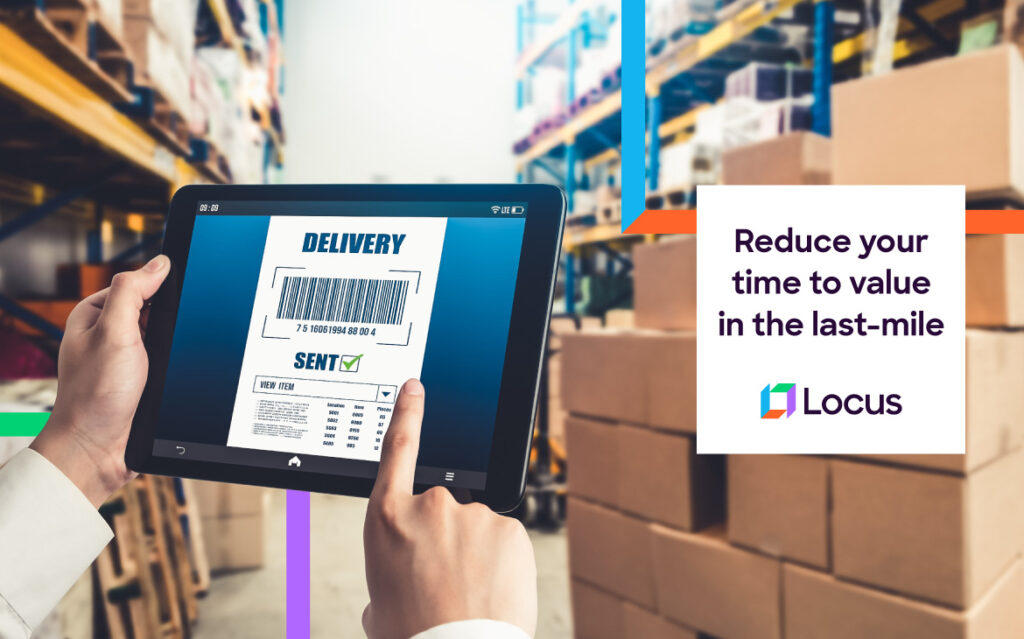
What would be the ideal response from any customer? Something along the lines of “Wow! This product is fantastic!” correct?
Time to value is the time taken for customers to get this “Wow” moment. But it’s easier said than done. Reducing time to value in SaaS products is an intricate task that follows a process. Locus, the dispatch management platform, follows a process that helps them reduce this time to value.
Identify business-specific challenges
Firstly, Locus’ sales representatives listen to the clients’ problems. Then, they identify the operational bottlenecks, business-specific challenges, constraints, workflows, processes, integration systems, and essential KPIs to show tangible improvements for this problem. This helps the Locus team create custom solutions that suit the business’ requirements.
Runs live simulations
In this step, Locus’ team runs the client’s problems through live simulations on real-time data. These simulations help obtain a holistic view of the current business operations and scenarios. This analysis is taken forward for effective, fast, and scalable implementation of the solution that is being designed.
Effective scaling and integration
Once the live simulations are over, Locus teams start scaling and integrating the solution and timeboxing those processes. With its simple, comprehensive, and developer-friendly API integration flows, it helps your businesses scale the simulated solutions across geographies and different systems.
Scaling simulated solutions and integrating them takes additional time when the business clients need more approval time. Some businesses might only need a standard integration, but some might need a complex integration based on their systems and processes.
Integrating complex systems will take additional time, and Locus gets these insights when they identify business-specific challenges. Whether it’s a standard integration or a complex one, Locus provides your business with a dedicated team to scale and integrate the solutions, ensure it goes live on time, and reap value.
Robust onboarding
After integrating and scaling the solution, the Locus team ensures that the solutions fulfill all the client requirements and get ready to go live. For every client, Locus assigns a dedicated account manager and a team to review the solution and ensure it goes live on time.
With expert insights, dedicated training, documentation, and customized weekly reports, Locus’ team enables robust onboarding for your business. It allows you to cope with speed on platform operations quickly, implement new processes and workflows and monitor operational changes after implementation. By ensuring this kind of robust onboarding, Locus’ team helps your businesses quickly achieve an ROI within a few weeks.
Quicker resolution of customer problems
Last but not least – Quicker resolution of customer issues. Suppose your solution goes live, and you start using it. If you want to resolve minor problems like bugs, you can get them done quickly using the Locus platform.
Locus’ team provides round-the-clock support with leading industry experts and a global support team. And its expedited ticket resolution time is less than 40 minutes. Quickly resolving these queries helps businesses drive profitability and improve fulfillment processes.
Minimize your time to value in last-mile delivery by leveraging the Locus platform
When a solution quickly provides value for your business, it respects your priorities, goals, and ambitions. This is why the Locus team emphasizes and ensures getting your time to value down.
By opting for Locus, your business can get onboarding assistance, expert support, and dedicated customer personnel to ensure your business gains value quickly. With Locus’ analytics and insights, it is easier to know if the values obtained reflect in numbers. The transparency, excellent customer support, and adherence to timelines ensure your time to value gets down.
Are you looking to reduce the time to value in the last-mile delivery?
References
https://www.espn.in/nba/story/_/id/35675259/adam-silver-says-nba-disciplines-referees-missed-calls
https://www.insiderintelligence.com/insights/last-mile-delivery-shipping-explained/

Last Mile Delivery Optimization
LastMile Dialogues: Maximizing unit economics to unlock last mile efficiencies

Feb 27, 2023
Industry leaders of the last mile from Indonesia come together to share their views on key and discuss to develop their last mile capabilities for real-world growth.
Read more
Tech and Product
Transform Your Delivery Process with Locus’ Automated Tracking System

Feb 28, 2023
Locus provides a white label tracking module that offers real-time tracking capabilities and automated notifications to customers about the status of their orders.
Read moreInsights Worth Your Time
















Time To Value And Its Importance For the Last Mile