

Last Mile Delivery Optimization
Last Mile Delivery: What Is It? How It Works in 2026?


Key Takeaways
- Last-mile delivery has become critical for business success as modern customers demand fast, transparent, and flexible delivery options across both B2B and B2C channels.
- The last mile represents the most expensive and time-consuming part of logistics, with key challenges including driver shortages, route inefficiencies, and unpredictable variables like traffic.
- Growing e-commerce sales, projected to reach $7.4 trillion by 2025, are driving increased demand for efficient last-mile delivery solutions and same-day shipping options.
- Locus’ dispatch management platform optimizes delivery routes using 180+ constraints while providing real-time visibility and sustainable logistics solutions to streamline last-mile operations.
The 21st-century customer is a tough cookie. They desire fast, speedy, and reliable order fulfillment without compromising on product quality. They demand transparency and regular updates, and they also want flexible delivery hours and in return, they offer their loyalty. These expectations aren’t limited to business-to-consumer (B2C) transactions; business-to-business (B2B) buyers expect the same speed and service, making it vital for retailers and logistics providers to operate in step with customer demands.
One crucial component of this evolving logistics puzzle is the last leg of the supply chain, often referred to as the last mile or final mile. This stage where goods are transported from distribution centers or stores to the customer’s doorstep has gained critical importance in today’s hyper-competitive market. Its direct interaction with the end customer makes last-mile delivery one of the most influential elements in shaping customer experience and brand perception.
What is the last-mile?
The term “last mile” refers to the final step in a broader process whether in logistics, telecommunications, or even transportation where services or products are delivered directly to the end user. In the context of supply chains, it’s the segment that connects distribution hubs to the customer’s location, and it’s often the most logistically challenging and expensive.
Originally coined in the telecom industry, the term now plays a major role in e-commerce and retail, where customer satisfaction hinges on a timely, seamless delivery experience.
What is last-mile delivery?
Last-mile delivery is the operational process behind transporting goods from a fulfillment center or local hub to the final destination, usually a home or office. It’s the point where logistics meet the customer face-to-face, making it crucial for businesses that rely on high customer satisfaction and repeat purchases.
In the supply chain, last-mile delivery follows:
- First mile: Movement from the manufacturer to a distribution center.
- Middle mile: Transfer from the distribution center to a local facility or retail outlet.
- Last mile: Final leg, from that local hub to the customer.
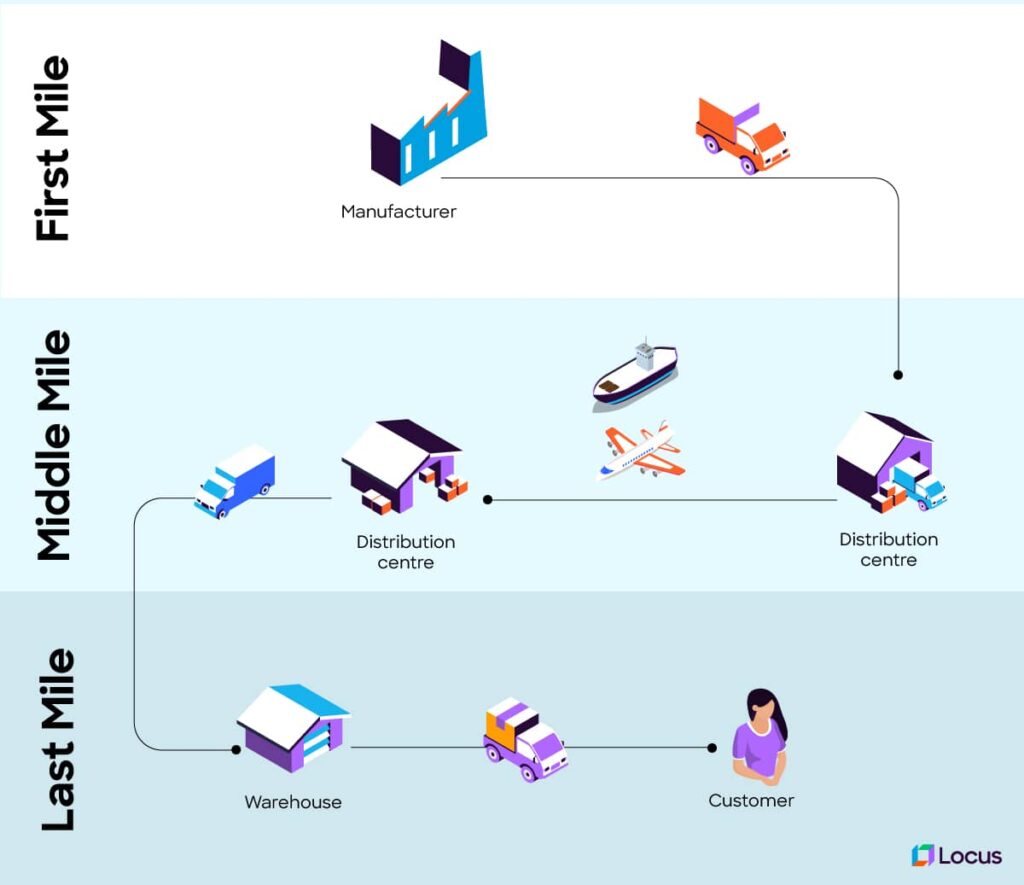
From groceries and clothing to electronics and furniture, efficient last-mile delivery ensures products arrive on time and in good condition. Innovations like route optimization, real-time tracking, and contactless delivery are now essential for executing this phase successfully.
The scale and importance of last-mile delivery have grown exponentially with the rise of global e-commerce. In 2021, retail e-commerce sales reached approximately $4.9 trillion worldwide, and this number is projected to grow by 50% to $7.4 trillion by 2025.
Importance of last mile delivery
Last-mile delivery has become one of the most pivotal elements in the supply chain. It is no longer just the final step in getting a product to a customer. It is where the brand promise is tested, customer satisfaction is defined, and competitive advantage is either secured or lost.
The last mile defines the customer experience
For most consumers, the delivery experience is their only physical interaction with a brand. The quality of that experience directly influences how the brand is perceived. Accurate deliveries, clear communication, and professional service create confidence and reinforce trust. On the other hand, delays, poor communication, or damaged goods can quickly undo months of marketing and sales efforts.
This stage has shifted from being a logistical necessity to a key touchpoint in the customer journey. Brands that treat last-mile delivery as a customer experience function, not just an operational task, consistently outperform those that do not.
It directly impacts revenue and retention
Customer expectations around speed and reliability have never been higher. In many cases, the delivery experience is as important as the product itself. If expectations are not met, customers do not hesitate to look elsewhere.
Poor last-mile execution leads to lower satisfaction, negative reviews, and reduced lifetime value. On the other hand, consistent delivery performance builds loyalty, encourages repeat purchases, and increases customer retention. In competitive markets where acquiring new customers is expensive, protecting existing relationships through strong fulfillment is a business imperative.
The last mile is the most expensive part of delivery
Although it accounts for a small portion of the physical journey, the last mile can account for more than half of total logistics costs. Labor-intensive handling, fuel expenses, congestion, and the need for flexible delivery windows all contribute to rising costs.
This complexity isn’t limited to large retailers. In a Reddit thread, a small cupcake business owner shared their struggle to balance fair delivery pricing with fuel and labor costs raising the same challenges of flat rates versus distance-based fees that larger operations face at scale.
Urban deliveries introduce additional complexity, with limited parking, traffic restrictions, and high stop densities. At the same time, consumers continue to demand faster, more personalized delivery options, which increases pressure on logistics networks. Businesses must strike a balance between meeting expectations and managing delivery costs without eroding margins.
Last-mile challenges are changing how companies deliver
The demands of last-mile delivery are forcing companies to rethink their supply chain design. Distribution models are shifting toward decentralization, with inventory stored closer to the point of demand. Retailers are investing in micro-fulfillment centers, route optimization tools, and real-time tracking systems to improve agility and visibility.
In fact, users in a Reddit thread on the future of last-mile delivery discussed how some startups are turning local retail stores into fulfillment hubs pushing delivery innovation beyond logistics and into new territory like returns and doorstep recycling. Companies are experimenting with electric delivery fleets, autonomous vehicles, and alternative delivery models to improve efficiency and sustainability. These changes are not just responses to operational challenges. They are strategic moves aimed at aligning logistics capabilities with evolving consumer expectations.
The Last-Mile Delivery Process
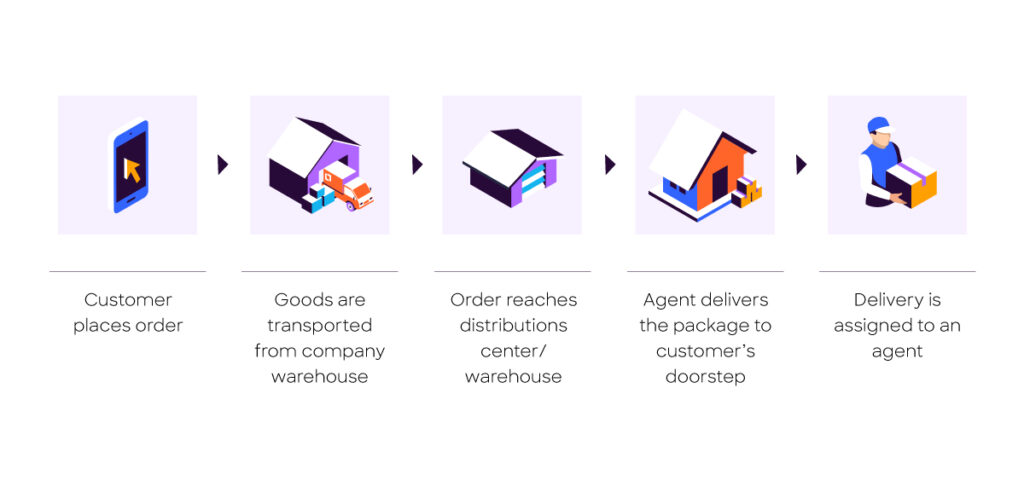
For operations executives and logistics strategists, the last mile is not just the endpoint of a delivery, it is a system-wide performance indicator. Everything upstream, from demand forecasting to warehouse layout, ultimately shows its success or failure in this final stretch.
Below is a breakdown of how last-mile delivery works in practice, who owns each stage, where the risks are, and how intelligent systems like Locus help operators gain control.
Step 1: Delivery Promise Begins at Checkout
The last mile begins before fulfillment. When a customer selects a delivery window same-day, next-day, or scheduled that choice becomes a time-bound commitment for the operations team. The accuracy of this promise depends on multiple factors: available inventory, fulfillment cut-off times, regional delivery capacity, and real-time routing constraints.
If these systems are not connected, businesses risk overpromising and missing SLAs before the package even moves. That is why leading operations teams align checkout logic with actual downstream capabilities, including order cutoff times and regional fleet availability.
Step 2: Fulfillment Center Processes the Order
After checkout, the warehouse or fulfillment center begins order processing. Items are picked, packed, and staged for handoff. The speed and accuracy of this stage directly affect downstream performance. A delay in staging or a mispick that requires repacking will cut into the available delivery window and increase the risk of a missed ETA.
This step also puts pressure on batch planning and shift schedules. If fulfillment and transportation teams are not operating on synchronized timelines, vehicles arrive before packages are ready, increasing dwell time and reducing delivery efficiency.
Step 3: Packages Are Assigned to Routes and Carriers
Once packages are staged, they need to be assigned to routes and delivery partners. This decision determines the cost-per-drop, route density, and whether the delivery can be completed within the promised window. Routing and carrier assignment is where many businesses either gain efficiency or lose it.
High-performing logistics teams assign deliveries based on a mix of factors including zone, service type, volume, and carrier availability. Static rules often lead to uneven distribution, underused vehicles, or delays in low-density zones. Dynamic allocation methods are increasingly replacing fixed routing plans to improve service levels and reduce operating costs.
Step 4: Routes Are Optimized and Dispatched
Route planning must go beyond simple geographic sequencing. Traffic, road conditions, customer availability, and vehicle types all affect route quality. For urban deliveries, high stop density must be balanced against time-per-drop, especially where access or parking is limited. In rural areas, fewer stops mean more driving time and higher cost per delivery.
Effective route optimization also considers time-of-day traffic patterns, weather events, and delivery time preferences. Once routes are finalized, the dispatch team coordinates timing, vehicle loading, and driver instructions for smooth execution.
Step 5: Delivery is Confirmed and Feedback is Captured
After the delivery, confirmation is logged and any exceptions are flagged. Proof of delivery must be tied to the order and customer record for operational visibility and customer service follow-up. This step also offers an opportunity to collect delivery feedback, which can be used to identify recurring issues or improve future delivery experiences.
The ability to tie customer satisfaction data to specific delivery events helps operations teams measure not just delivery speed, but quality. This becomes essential when scaling delivery operations across regions, partners, or new service levels.
Why the Last Mile Requires Coordination, Not Just Speed?
Each step in the last-mile process affects the next. A delay at fulfillment compresses delivery windows. Poor routing inflates cost per order. A failed drop creates reattempts and customer dissatisfaction. Treating each phase as a silo leads to inconsistent service and rising operational complexity.
Leading logistics teams approach the last mile as an interconnected system. They focus on orchestration ensuring that systems, people, and processes work together in real time to deliver not just parcels, but on-time, high-quality experiences.
Download our whitepaper: Find the Right Balance in your Last Mile Delivery
What makes last-mile delivery successful?
Delivering the order to the customer on time is important, but it is not the only factor in determining a positive experience with the customer. Speed, efficiency, transparency, and personalized experience all play an important role in making last-mile delivery successful.
Speed, in particular, has become a non-negotiable for an increasing number of customers when it comes to food and grocery delivery. In fact, customers will gladly pay a premium if it means that shipping times can be accelerated.
Understanding The Last-Mile Problem
The last mile is a bit of a conundrum. While customers are always seeking deliveries that are free and fast, last-mile delivery is also the most expensive and time-consuming part of the supply chain. According to a Statista report, one-third of the respondents of a survey of key stakeholders from postal, parcel, and logistics enterprises say the biggest challenge in last mile delivery in North America is the lack of qualified drivers for hire, closely followed by last-mile process inefficiencies.
Not only are last-mile processes difficult to plan, but the volume of deliveries also fluctuates according to the seasons, making it difficult for delivery companies to keep up and they often take help from external service providers. Planning an ideal standardized delivery route is difficult as it is impossible to take all the variables into account: traffic congestion, limited parking space, unclear addresses, among others. And so, there is always an element of unpredictability that remains a part of the last mile operation.
Key Challenges in Last-Mile Delivery
- Fulfilling orders on the same day: As quick commerce grows popular and same-day deliveries become the norm, businesses struggle to plan routes efficiently and utilize vehicle capacity in an optimum manner.
- Visibility in the supply chain: One of the reasons that make the last mile a time-consuming process is that most logistics managers don’t have the supply chain monitoring infrastructure that allows them to look into all the systems at any given point. Delays, vehicle idling, inaccurate Expected Time of Arrivals (ETA), and route diversions are all a result of poor visibility.
- Controlling carbon emissions: As transportation contributes greatly to the world’s carbon emissions, it is important to reduce fuel consumption and miles traveled in the final stages of the last mile. More and more consumers are willing to pay extra to support sustainability and carbon neutral deliveries can be a great way to do that.
Top 5 Trends in Last-Mile Delivery for 2025
Last-mile delivery is no longer just a logistics function. It has become a strategic differentiator, a cost control lever, and a direct extension of customer experience. Here are five trends that are shaping how high-performing logistics teams approach the last mile.
1. Smarter Routing with AI and Machine Learning
Artificial intelligence and machine learning are moving from pilot programs to core infrastructure. Logistics operations are now using AI-powered systems to optimize delivery routes based on real-time data such as traffic patterns, weather conditions, and service-level commitments. These tools adapt continuously to changing conditions and historical performance. Benefits include:
- Reduced fuel usage and delivery mileage
- Better driver allocation and route density
- Higher on-time delivery percentages
Companies that invest in AI-driven routing are gaining measurable efficiency and greater reliability in high-volume environments.
2. The Reinvention of Retail Distribution Centers
Retail distribution centers are evolving into agile, multi-purpose nodes within the supply chain. Rather than serving only physical store replenishment, RDCs are increasingly designed to support direct-to-consumer fulfillment with faster turnaround and localized inventory management. Key developments include:
- Integration with real-time inventory and order systems
- Increased automation in picking and staging
- Support for local deliveries with shorter lead times
Retailers are adapting these centers to respond more quickly to online demand, reducing the gap between product availability and final delivery.
3. Same-Day Delivery Becomes the New Normal
Consumer expectations continue to accelerate. What was once seen as a premium service is now becoming standard in many urban and suburban areas. Same-day delivery is now a baseline offering for fast-moving products and competitive markets. Operational requirements include:
- Shorter fulfillment cut-off times and localized inventory placement
- Increased use of micro-fulfillment hubs and store-based delivery
- Tighter coordination between order systems and delivery fleets
To remain competitive, logistics providers must build fulfillment and routing systems that can operate in near real time.
4. Green Logistics Moves to the Forefront
Sustainability is now an operational requirement rather than a secondary goal. Consumers want environmentally responsible delivery, and regulators are tightening standards on emissions, waste, and fleet efficiency. Adoption trends include:
- Route optimization to reduce emissions per order
- Investment in electric vehicles and alternative delivery modes
- Shift to recyclable and biodegradable packaging materials
Businesses that embed sustainability into last-mile planning are improving cost efficiency, meeting compliance targets, and strengthening brand perception.
5. Predictive Analytics Enables Proactive Operations
With increasing order volumes and regional variability, predictive analytics is becoming essential to maintain performance. By analyzing historical order data, seasonal patterns, and real-time behavior, companies can forecast delivery demand and adjust their operations accordingly. Common use cases include:
- Anticipating order spikes by region or time slot
- Adjusting driver schedules and fleet distribution ahead of volume shifts
- Preemptively managing delivery exceptions to protect SLAs
Predictive analytics helps logistics teams reduce uncertainty, respond faster, and build more resilient delivery networks.
Logistics teams that adapt to these trends with the right strategy, systems, and partnerships will be best equipped to serve modern consumers and protect margins in a high-pressure market.
How Locus Streamlines Last-mile Delivery with Ease?
Last-mile delivery continues to be one of the most complex and costly stages in the supply chain. The path to a seamless customer experience is often blocked by multiple inefficiencies; orders may be delayed, misplaced, or mishandled; drivers are frequently dispatched with suboptimal routes, leading to missed time windows; and limited real-time visibility creates frustration for both customers and operations teams. Miscommunication between drivers, dispatchers, and customers further compounds the challenge, resulting in lower delivery success rates and higher service costs.
To overcome these roadblocks, more logistics providers are investing in technology that brings clarity, automation, and control to the last mile. Locus’ dispatch management platform offers an end-to-end solution that helps businesses improve operational performance, drive customer satisfaction, and scale delivery networks efficiently. Here are four key ways it supports logistics optimization.
- Unified Control
Locus acts as a single source of truth across the fulfillment cycle. Its integrated platform connects all delivery workflows, order allocation, routing, tracking, and task management so every stakeholder works from the same accurate, real-time data. All applications are fully interoperable, ensuring smooth communication between systems and eliminating process silos.
- Smarter Routing
The platform considers more than 180 real-world constraints to generate optimized, multi-stop routes and optimization of delivery routes. From traffic congestion and vehicle types to customer preferences and service-level commitments, every factor is accounted for. Built-in parcel sorting and automated task assignment help drivers start faster and spend less time in preparation.
- Full Visibility
Locus offers complete visibility across all fulfillment models and delivery channels. Dispatchers can monitor deliveries from pickup to proof of delivery, while order-level tracking ensures accurate status updates. A dedicated driver app supports GPS navigation, real-time communication, and digital proof of delivery, improving both control and responsiveness.
- Full-Integration
The platform integrates easily with WMS, OMS, TMS, and CRM systems, creating a consistent data flow across all functions. This interoperability allows businesses to preserve their existing tech stack while gaining the benefits of automated dispatch and real-time decision-making at scale.
- Sustainable Growth
Locus helps reduce environmental impact by planning smarter, more efficient delivery routes. It accounts for zone-based driving restrictions, traffic patterns, rider preferences, and vehicle types. The result is fewer miles driven, reduced fuel consumption, and long-term cost savings that support both profitability and sustainability goals.
The last mile doesn’t have to be expensive and time-consuming. Businesses must take cues from the ongoing dynamics in last-mile logistics and prepare for the future with technology as well as agile last-mile strategies by their side. Speak to our experts and see how Locus can be your last mile delivery partner.

Route Optimization
What is Multi-Stop Route Planning? Importance & Benefits

Sep 1, 2025
Multi-stop route planning selects the optimal and most productive route for visiting multiple customer locations. Learn about multi-stop route optimization!
Read more
Last Mile Delivery Optimization
What is Last-Mile Tracking? Benefits & Challenges [2025]
Sep 1, 2025
The process of monitoring and managing the final stage of delivery, which is the complex and expensive part of the supply chain, is known as last-mile tracking.
Read moreInsights Worth Your Time
















Last Mile Delivery: What Is It? How It Works in 2026?